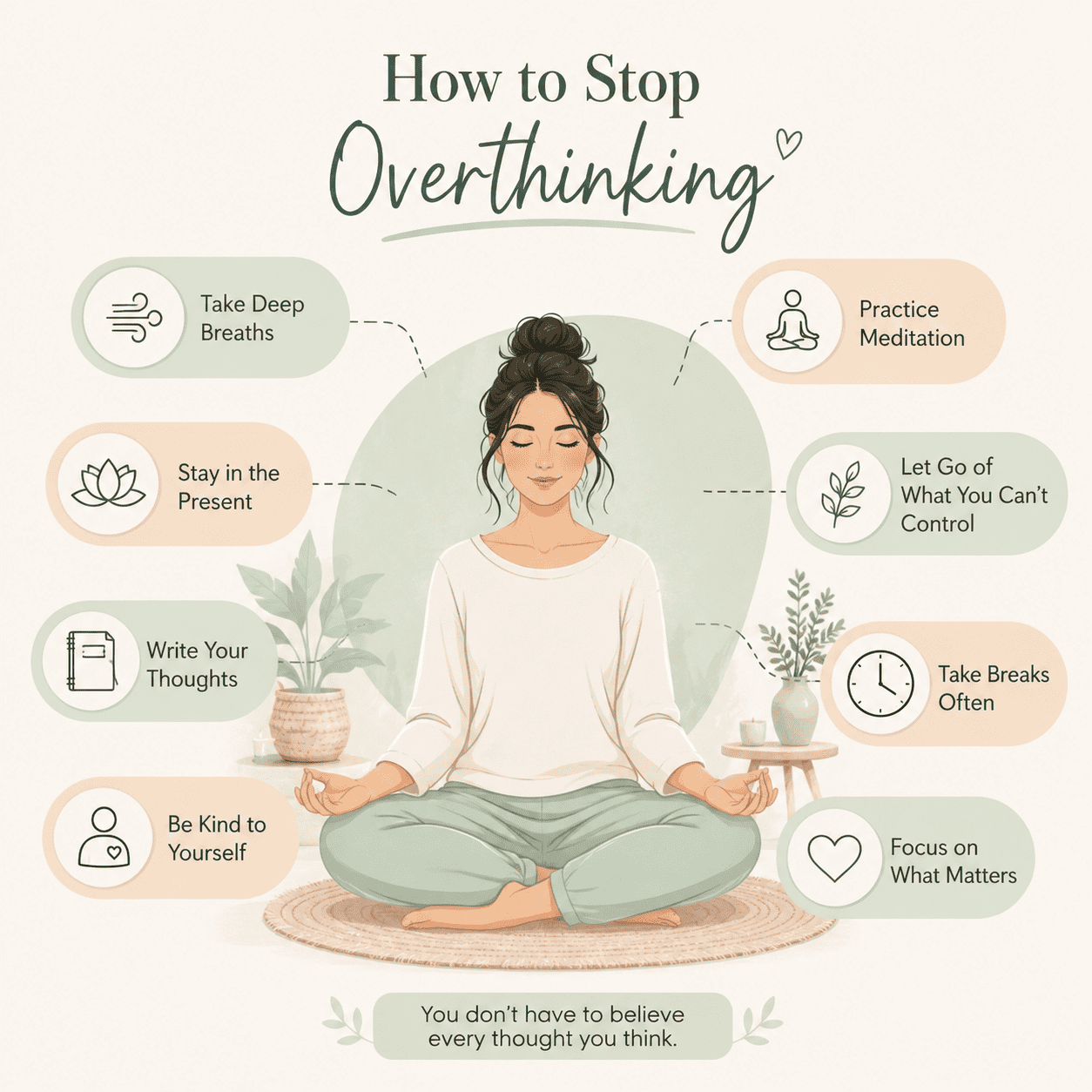
Have you ever replayed the same conversation in your mind over and over?
Or spent hours worrying about something that hasn’t even happened yet?
If yes, you’re not alone.
Almost everyone overthinks at some point. It often starts with a simple thought, but before you know it, your mind has created dozens of “what if” scenarios.
You may know you’re overthinking, but stopping it feels much harder than you expected.
The good news is that overthinking isn’t a permanent part of who you are. It’s a habit your mind has learned, and like any habit, it can be changed.
What Is Overthinking?
Overthinking is when your mind keeps going in circles without reaching a solution.
Instead of helping you move forward, your thoughts keep pulling you back.
You replay the past.
You worry about the future.
You imagine situations that may never happen.
The more you think, the more exhausted you feel, even though nothing has actually changed.
Why Do We Overthink?
There isn’t just one reason. Overthinking often grows from small habits and emotions that build up over time.
1. You Want Everything to Be Perfect
Sometimes we believe that if we think long enough, we’ll make the perfect decision.
But life rarely works that way.
Waiting for complete certainty often leaves us feeling stuck instead of confident.
2. You’re Afraid of Making Mistakes
Many people overthink because they fear choosing the wrong path.
“What if I fail?”
“What if people judge me?”
“What if I regret this later?”
These questions keep the mind busy, but they don’t always bring useful answers.
3. You’re Carrying Stress
When life feels overwhelming, the mind naturally tries to solve every possible problem.
It believes that thinking more will make you feel safer.
Instead, it often creates even more stress.
4. You’re Not Living in the Present
Overthinking usually takes you away from the present moment.
Your mind is either revisiting yesterday or worrying about tomorrow.
Very little of your attention stays with what is happening right now.
How Can You Stop Overthinking?
You don’t have to stop every thought that comes into your mind.
Instead, you can learn not to let every thought take control.
1. Ask Yourself One Simple Question
Whenever you notice yourself going in circles, pause and ask,
“Is this thought helping me, or is it only making me worry more?”
Sometimes this simple question is enough to break the cycle.
2. Focus on What You Can Control
You cannot control every outcome.
You cannot predict every possibility.
But you can control your next small step.
Instead of trying to solve everything, ask yourself,
“What is one thing I can do today?”
Small actions often quiet the mind more than endless thinking.
3. Give Your Mind Some Rest
Your mind wasn’t designed to work all day without a break.
Spend a few minutes in silence.
Take a walk.
Read a book.
Practice meditation.
Even a short pause can help your thoughts slow down.
4. Accept That Uncertainty Is Part of Life
No one has all the answers.
No one knows exactly what tomorrow will bring.
The more we accept uncertainty, the less power it has over us.
Peace doesn’t come from knowing everything.
It comes from trusting yourself to handle whatever comes your way.
A Gentle Reminder
Your thoughts are a part of you, but they are not you.
Not every thought deserves your attention.
Not every worry deserves your energy.
The next time you catch yourself overthinking, take a slow breath and remind yourself that you don’t need to solve your entire life today.
Sometimes, the clearest answers appear not when we think more, but when we become still enough to listen.
That small moment of stillness may be exactly what your mind has been asking for.